For decades, event rental companies have sold experiences they couldn't fully show. A client would look at a flat floor plan, squint at a stack of catalog photos on a “mood board”, and try to imagine how forty round tables, a sailcloth tent, and a pipe-and-drape backdrop would actually look at their venue. Somewhere between that imagination gap and the final invoice, deals stalled, revisions piled up, and quotes went out days later than they should have.
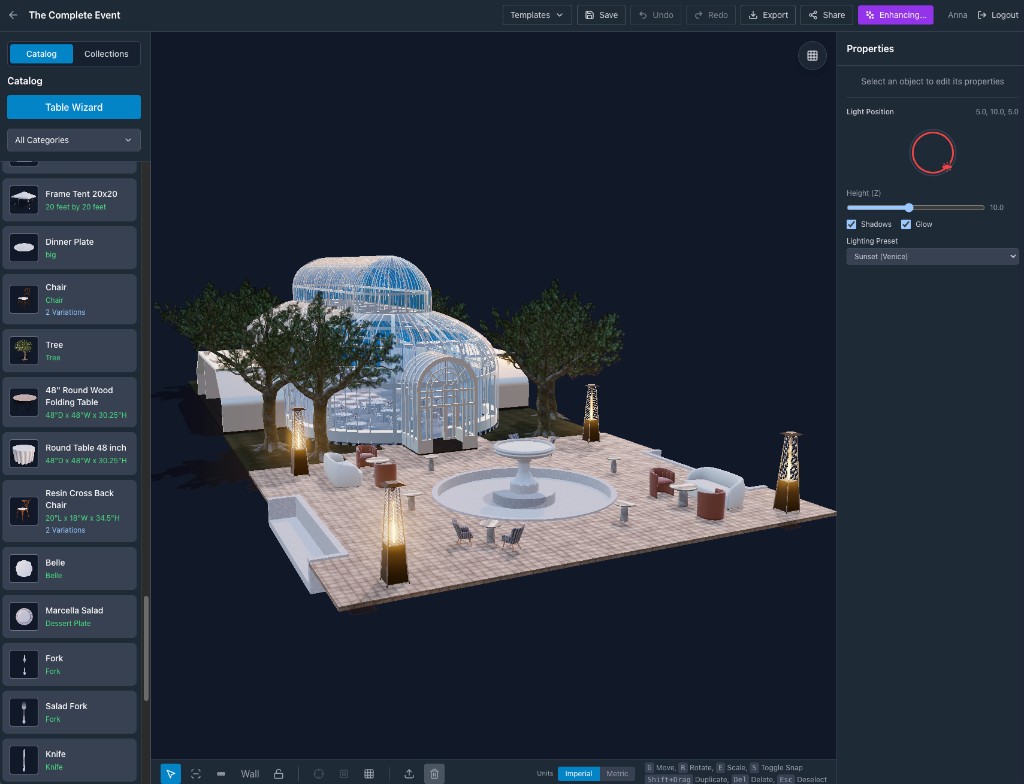
That gap is closing fast. AI-powered 3D event design software is reshaping how rental companies design, present, and price events, and the shift is happening at every stage of the sales and planning process, not just in the render itself. Platforms like Event Design App™ are built around exactly this shift: turning a rental company's real inventory into a real-scale 3D space and an itemized quote, in one browser, without the hand-offs that used to slow everything down.
The Old Workflow Was Never Built to Scale
Traditional event design tools fall into two camps: static 2D floor plans or heavyweight CAD software built for architects, not event professionals. Neither connects design to inventory. A planner sketches a layout, someone else manually counts chairs and linens, and a third person builds the quote in a spreadsheet or event rental management software. Every step is a hand-off, and every hand-off is a chance for a mistake — the wrong tent size, a miscounted table order, a quote that doesn't match what was actually presented.
This is the exact gap Event Design App was built to close. Instead of a separate sketch, a separate inventory count, and a separate quote document, it puts all three in one place — so the person designing the event, the person pricing it, and the person fulfilling it are working from the same source of truth.
What “Connected 3D” Actually Means
The newest generation of event design platforms solves this by connecting the visual design directly to real inventory and real pricing — an approach often called “Connected 3D.” Instead of a static rendering that has to be manually matched to a quote afterward, every item placed in the 3D scene is already tied to its SKU, its rental price, and its availability.
That connection changes the sales conversation entirely. A rental company can walk a client through a photorealistic 3D version of their event on a first call, drag in a few more lounge chairs or an additional bar setup, and watch the itemized quote update in real time. What the client sees is exactly what they're charged for — no reconciling a beautiful rendering with a separate, less beautiful invoice.
Connected 3D is, in fact, the term Event Design App uses to describe its own core design principle: what you place is what you price. Every chair, tent panel, and drape pulled into a design is tied to the company's actual catalog and rate sheet, so the “Design → Quote” step isn't a second pass — it's a byproduct of designing at all.
AI Is Removing the Biggest Bottleneck: 3D Inventory
The single biggest barrier to adopting 3D design has always been content. Rental companies own thousands of physical items, and modeling each one in traditional 3D software — chairs, tents, arches, drapery, specialty decor — could take a professional 3D artist weeks per item and cost a premium per SKU. Most companies simply couldn't justify digitizing their full catalog.
AI-powered photo-to-3D generation removes that bottleneck. A team member photographs a piece of furniture or decor, uploads the image, and the software generates a usable 3D model automatically, saving it directly to the company's catalog. What used to require outsourcing to a specialized 3D studio and waiting weeks now happens in-house, in minutes. Rental companies can build out a full catalog — including one-off custom pieces and new product lines — on their own timeline, without ongoing outsourced modeling costs.
This is precisely the workflow Event Design App's AI tools are built around: snap a photo of a piece of inventory, and the app builds the 3D model and files it into the catalog automatically. A company's entire inventory can become design-ready without ever opening a traditional 3D modeling program.
This matters more than it might first appear. It means a company's 3D catalog can actually keep pace with its physical inventory, instead of lagging years behind it with only a handful of “hero” pieces modeled for marketing purposes.
True-to-Scale Design Solves the Trust Problem
Another persistent challenge in event design has been scale accuracy. A rendering that looks great but doesn't reflect real dimensions creates problems on install day — a tent that doesn't actually fit the yard, a dance floor that crowds the seating, a stage that needs railing nobody accounted for.
AI-assisted true-to-scale tools address this directly. Users can upload a venue floor plan or a Google Maps aerial image, measure a single wall or reference point, and the software scales the entire space automatically. From there, tents, furniture, and staging are placed using real dimensions rather than approximations. For rental companies that specialize in tenting, this extends to fully configurable tent builders — frame tents, pole tents, sailcloth, and high-peak marquees — where sidewalls, interiors, and drape can all be designed against the tent's actual structural dimensions.
Event Design App's own pro tip captures this well: measure one wall, and let AI scale the whole venue. Upload a floor plan or a Google Maps view, calibrate a single dimension, and the entire layout — including its tent builder for frame, pole, sailcloth, and high-peak marquee structures — snaps to true scale in seconds.
The result is a design that isn't just pretty. It's buildable, which reduces costly surprises for both the rental company and the client.
Why This Shift Matters for the Rental Business, Not Just the Client Experience
It's tempting to think of 3D visualization purely as a client-facing nicety — a way to impress people during the sales process. But the operational upside is arguably bigger.
Faster closing. Visual, itemized quotes consistently outperform text-based estimates. When a client can see and understand exactly what they're buying, hesitation drops and approval speeds up.
Fewer errors between design and delivery. Because the 3D design is connected to real inventory, what gets designed is what gets pulled from the warehouse — not a rough approximation reconciled later by an operations team.
Lower cost of new inventory. AI-generated 3D models mean new products can go live in the catalog and in client designs almost immediately after they're purchased, rather than waiting for a modeling backlog to clear.
Better internal handoffs. Technical floor plans generated from the same design used in sales give setup crews accurate, real-measurement references — instead of a separate document built from scratch.
Together, these advantages compress a process that used to take days into one that can genuinely happen in minutes, from a client's first call to a signed contract. It's the same claim Event Design App makes about its own numbers: rental companies using the platform report closing deals roughly 3x faster, with high-resolution renders generated in under two minutes — because the design, the quote, and the sales conversation are no longer three separate steps.
What to Look for in an AI-Powered Event Design Platform
Not all “3D event software” delivers on this promise equally. Rental companies evaluating a new platform should look for a few specific capabilities:
- Inventory integration, so designs are built from real, in-stock items rather than a generic asset library
- Instant, itemized quoting directly from the 3D layout
- AI photo-to-3D modeling, so the catalog can grow without outsourced 3D studio costs
- True-to-scale mapping, including floor plan and aerial map import
- Browser-based access, so designers, sales teams, and even clients can use it without installing specialized software
- Tent and staging configuration tools, if tenting or staging is part of the business
Platforms that combine all of these — rather than offering 3D visuals as an isolated add-on — tend to deliver the biggest gains, because the value comes from the connections between design, inventory, and pricing, not from any single feature in isolation. Event Design App is one of the few platforms built to check every item on this list from the ground up, rather than bolting 3D visuals onto an existing quoting tool after the fact — which is worth factoring in when you're comparing how deep each platform's “3D design” claim actually goes.
The Bottom Line
Event rental is, at its core, a business of turning imagination into a booked, buildable, correctly priced event. AI-powered 3D design doesn't replace the expertise event professionals bring to that process — it removes the friction that used to sit between a great idea and a signed contract. As more rental companies adopt connected, AI-assisted design tools, the gap between “what the client imagined” and “what actually gets delivered” keeps shrinking, and that's good news for everyone at the table.
Event Design App is one of the clearest examples of this shift in practice — built specifically so event rental companies can design, quote, and win business inside a single, 100% web-based tool, with nothing to install and no separate 3D studio required.